I first learned of visual journaling from Lisa Sonora – from whom I took my first ever online course. Her work in the book THE CREATIVE ENTREPRENEUR and visual journaling was the inspiration for the direction I’ve taken my private coaching practice and group work with entrepreneurs and creatives.

Flash forward. Covid. Uprisings. Life gets in the way. My personal practice of journaling is set aside.
But lately I’ve been feeling the call of creativity. And then the idea of visual journaling started to pop back up here and there … I need to pay attention.
👈🏻 is a photo of the journal I designed for the 2010 conference. The one pictured here is well loved and I received many kudos for this little book… I used mine to capture my thoughts and ideas as well. 👇🏻
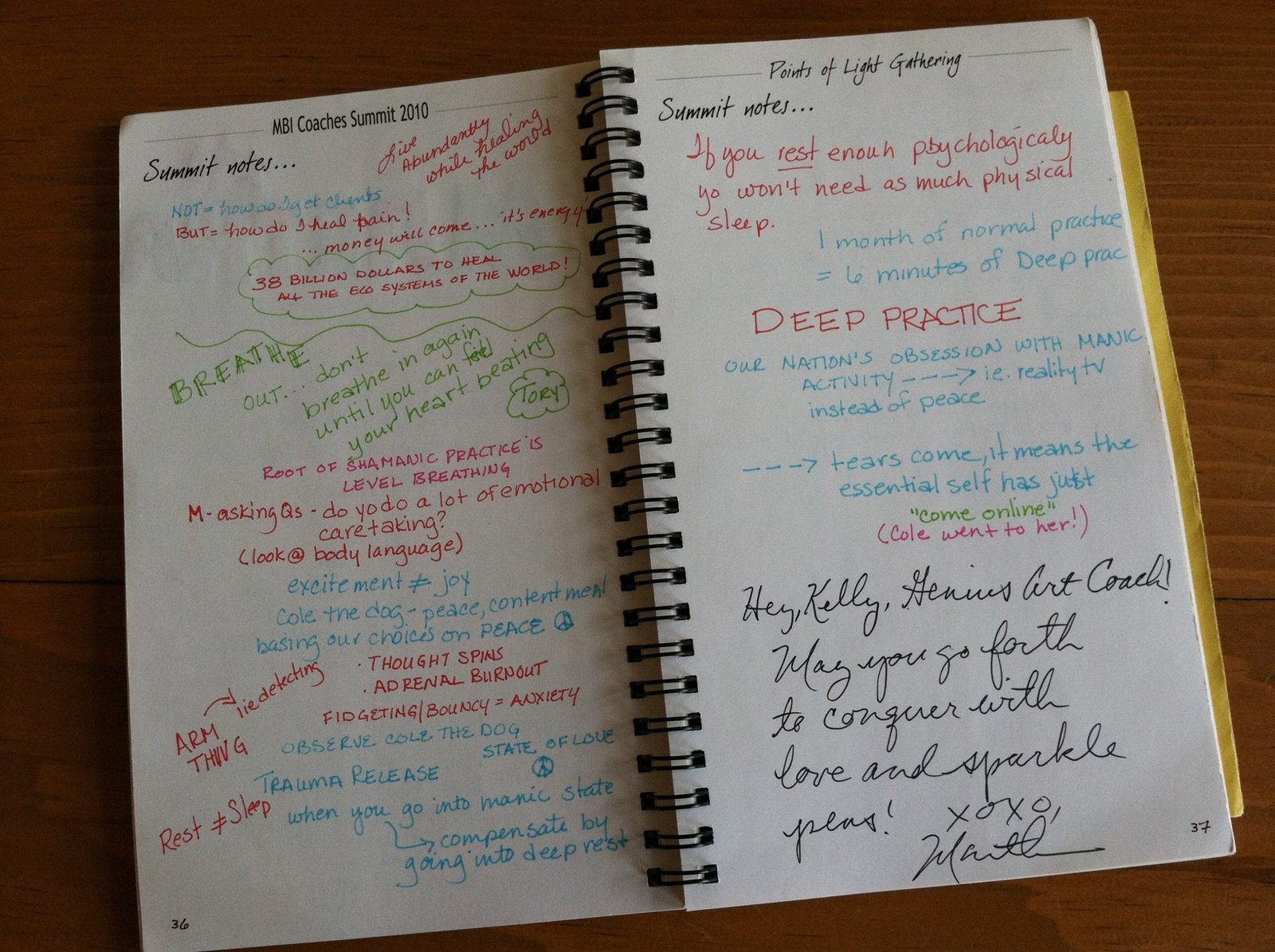
One of the emails I received post-conference was from sister coach, Florence Moyer. It said
I’m having a blast with my visual journal and I just posted on my blog about some of the things I’m learning from it. Hope you enjoy it and that I’m representing your ideas well.
– Flo
Her post did indeed represent my ideas well, which were Lisa’s ideas.

(Oh, and by the way, it was inn 2010 at Lisa Sonora‘s creativity retreat in Mexico that joy and I first met! We’ve never been in the same physical space again, but a life time friendship and partnership was formed! All around visual journaling)
Without Further Ado, Here’s Flo’s Blog Post from August of 2010
Playing with Art Supplies:
Six Cool Things About Visual Journaling
Playing with Art Supplies: Six Cool Things About Visual Journaling
By
Florence Moyer
I’ve kept journals fairly regularly since I was a college freshman.
The PreDigital Era
I started with cheap spiral notebooks and ballpoint pens, scrawling as fast as my hand would move, writing just about anywhere I could carry my notebook and a pen.
It’s 5 a.m. Somewhere
Upgrading to beautifully bound journals and fountain pens in grad school, I discovered “morning pages,” Julia Cameron’s tool from The Artist’s Way. Mine tend to be evening pages during the school year. In spite of modifying her guidelines, I find that writing some time every day works better than writing in the morning only occasionally.
Going Digital
I’ve tried keeping digital journals a few times with little success. I spend most of my computer journaling in editing-mode rather than writingmode, aiming for perfection rather than simply getting raw ideas from brain to page. Wireless internet has made this method even less workable, since the temptation to drop by the ‘net “for a second” is irresistible.
I’m Supposed to Do WHAT in my Journal?
I learned about visual journaling from Life Coach Kelly Pratt and the program book/journal she generously contributed to the swag bags at the 2010 Martha Beck Coaches’ Convention.
Kelly’s creation is beautiful, even if almost none of the pages are lined. And even if we’re encouraged to draw as well as write in it. Seriously?
OK, journals I get: write your feelings and maybe change your life.
Vision boards? I get those, too: cut out a bunch of pictures, stick them on a poster, and let the universe take over in manifesting your heart’s desires.
But draw in a journal – without lines – freehand? Like that’s gonna happen.
The whole idea was strangely irresistible, though, so I dropped in on Kelly’s followup call where she made visual journaling sound a lot less scary and kind of, well, fun. I’m an art supply junkie – love to look at them, scared to use them – and here was this woman giving me permission to play with them. Cool.
In a month, I filled a grand total of four two-page spreads in my visual journal. Minimal output, but darned if the process isn’t doing just what Kelly predicted: it’s changing my life.
So now I’m a Visual Journaling Believer, and here are six reasons why you just might become one too:
1 You get to play with art supplies.
Absolutely no pressure to make art. Just play with cool stuff like beautiful looking, smelling, and feeling colored pencils, crayons, oil pastels, and pens. You can even get the page wet with water paint!
2 You have a place to put all of those pictures you cut out from magazines.
I needed a break from the vision board thing, but I still loved cutting out beautiful images. Stashing them in a folder felt wrong, so I happily incorporate them into my visual journal.
3 There are no spelling mistakes.
There are no mistakes, period. When you play with art supplies, you get to incorporate “mistakes” into the creation.
4 You get to use your brain differently.
My first sense was that the “art stuff” doesn’t take as much concentration as writing, but I soon realized that my brain was just working differently. I struggle to write when I can hear speaking or familiar tunes (no small thing, since I know about twenty gazillion tunes), but I find I can easily paint or draw no matter what sounds are around me.
5 You can fool people into thinking you’re really an artist.
My 5-year-old godson visited when my art supplies were out on the table, prompting him to ask,
“Florence, are you becoming an artist?” To him, my “becoming an artist” was perfectly logical and ordinary, and my own inner 5-year-old is one board with that thought, too.
6 Visual journaling really does make magical feeling things happen.
One night last week I drew a small sailboat in my visual journal. During lunch the next day, without really knowing why, I looked up “sailboat” on craigslist. That evening, I made a deposit on a terrific little boat at a great price from nice people who live four miles from me on a street I’d never seen before. It’s the exact boat I’ve wanted since I made my first vision board two summers ago.
Just below the boat, I drew a book and a podium. I’m sure that writing the book and doing the book tour is going to happen just as easily and at exactly the right time.
What will you create in your visual journal?

 the equinox means there will be equal number of hours of daylight and darkness. from here, the days will shorten until the winter solstice, or shortest day of the year.
the autumnal equinox opens the season of harvest: abundance, gratitude, reflection and renewal. traditionally the closest full moon to the autumnal equinox is called the harvest moon–which already passed, on September 10th.
the equinox means there will be equal number of hours of daylight and darkness. from here, the days will shorten until the winter solstice, or shortest day of the year.
the autumnal equinox opens the season of harvest: abundance, gratitude, reflection and renewal. traditionally the closest full moon to the autumnal equinox is called the harvest moon–which already passed, on September 10th.
 Ready to collaborate? Here’s how you can get started. Athena village is a community for and by women, which means it’s made for collaboration.
Whether collaborating on a craft project or building a business event together it’s possible and Athena village is the best place for it. Here are a few ways to get started.
Do you have a hobby? Offer to share your skills in virtual or live meetups with women in your area. Post about your hobby, share why you love it, and invite others to share their…
[
Ready to collaborate? Here’s how you can get started. Athena village is a community for and by women, which means it’s made for collaboration.
Whether collaborating on a craft project or building a business event together it’s possible and Athena village is the best place for it. Here are a few ways to get started.
Do you have a hobby? Offer to share your skills in virtual or live meetups with women in your area. Post about your hobby, share why you love it, and invite others to share their…
[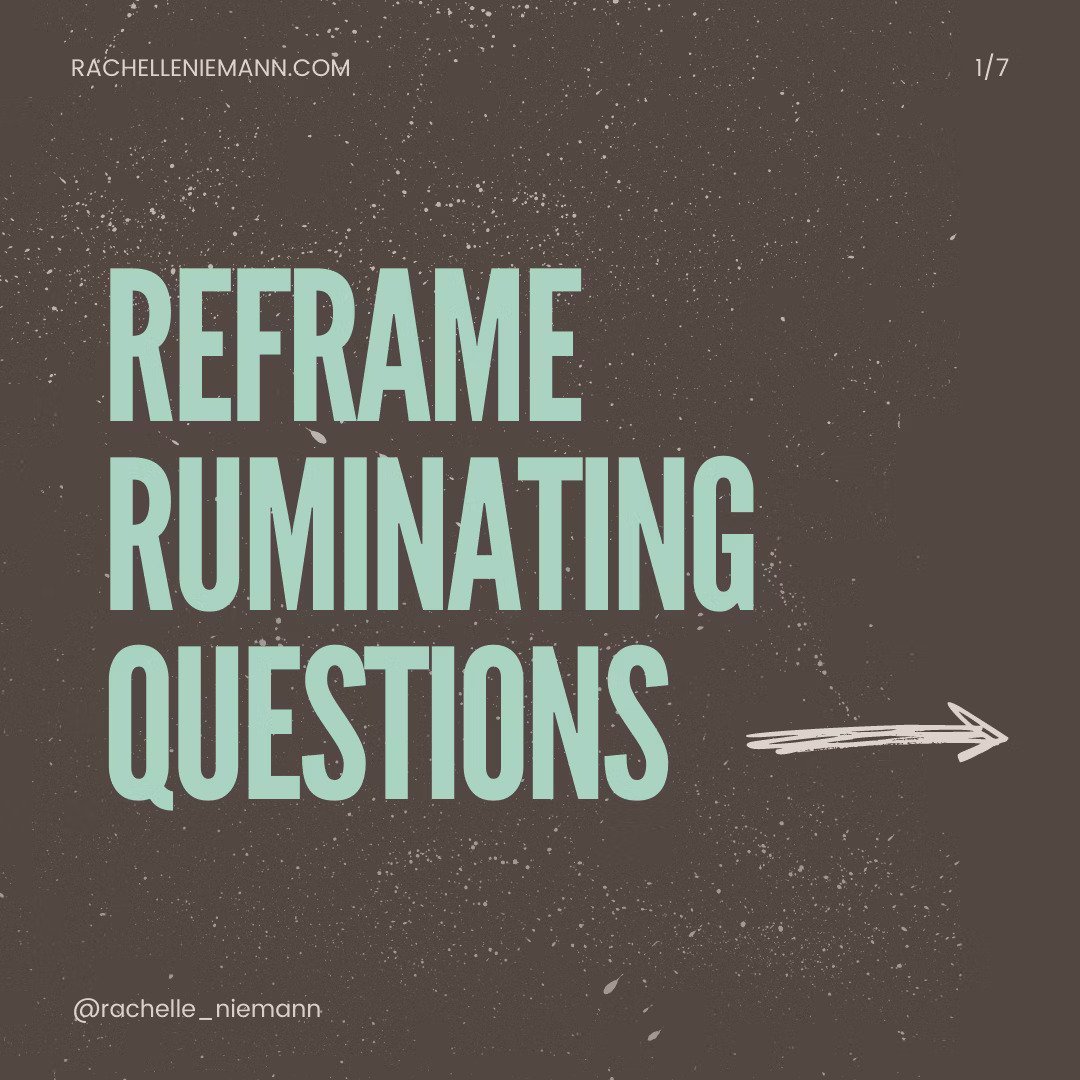 Do you have ruminating questions that keep coming back to you?
Yeah, me too! Often times we are asking circular questions that lead us back to the same situation. When we ask a question, our brain automatically starts looking for answers and/or evidence. When we ask questions like,
Do you have ruminating questions that keep coming back to you?
Yeah, me too! Often times we are asking circular questions that lead us back to the same situation. When we ask a question, our brain automatically starts looking for answers and/or evidence. When we ask questions like,
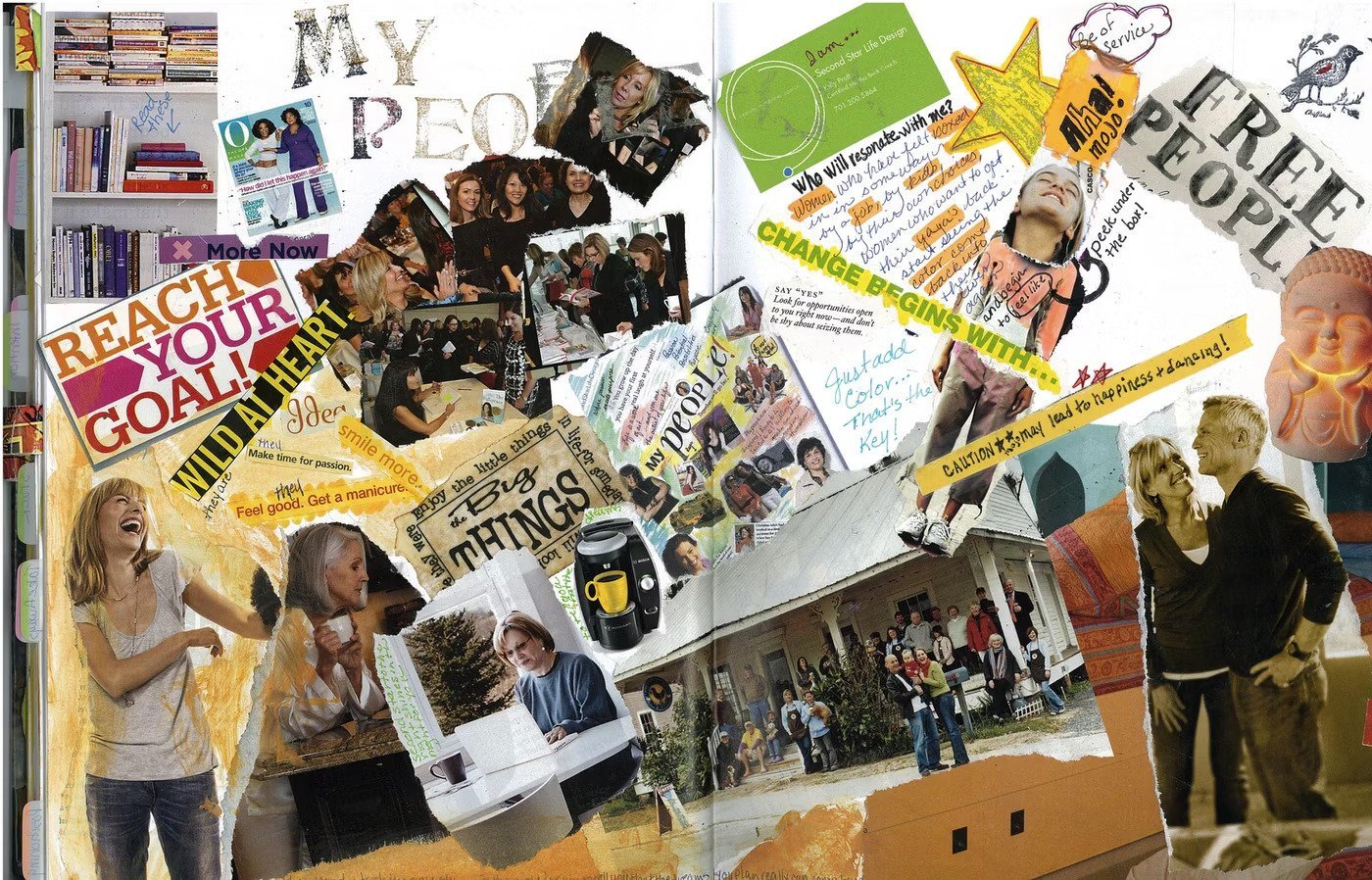
 (scroll to the bottom of this article to see a younger me explaining why i love visual journaling)
“Years ago I was deep into my practice of Visual Journaling – personally, and professionally.
In addition to using my journal to work through personal and business ideas, issues and thoughts, i was designing journals for others, including a journal for all the coaches attending Martha Beck’s Coaches’ conferences.”
(scroll to the bottom of this article to see a younger me explaining why i love visual journaling)
“Years ago I was deep into my practice of Visual Journaling – personally, and professionally.
In addition to using my journal to work through personal and business ideas, issues and thoughts, i was designing journals for others, including a journal for all the coaches attending Martha Beck’s Coaches’ conferences.”

